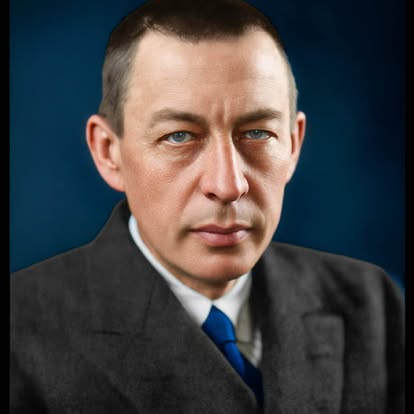
By Dr. Anthony La Magra
Part 1 of this series on Sergei Rachmaninoff explored his life from student days through his career as composer, conductor and pianist in Russia, a period when he composed the bulk of his music output and developed a respected reputation as a conductor and performer, until his forced departure from Moscow to Denmark due to political upheaval in 1917.
After a long and uncomfortable journey from Moscow, Sergei Rachmaninoff and his family arrived in Stockholm on the afternoon of December 24, 1917. It was Christmas Eve, and the gaiety of the holiday shoppers only increased the loneliness and anguish of the exiles. The scheduled concerts had to be put aside until Rachmaninoff’s mind and fingers were ready to work. With the assistance of his concert manager friend, Nicolai Struve, a house with a piano was rented in the suburbs of Copenhagen and Rachmaninoff plunged into practice for his Scandinavian Concerts.
Rachmaninoff’s first appearance there was on February 15, 1918, playing his Second Concerto with the Copenhagen Orchestra. A week later he gave a recital of his own compositions in Copenhagen, including the Prelude in G minor, perhaps the second most popular of his solo works. The captivating march rhythm of the first part is unusual in the composer’s music, while the beautiful lyrical melody and romantic sonority of the middle section are a common occurrence.
During the next three and a half months, Rachmaninoff fulfilled his Stockholm contract, ending his concert season on July 11, 1918. With the fees for the 12 concerts, he was able to pay many of his debts and rest long enough before having to decide on his future. One thing was clear: in order to provide for his family, he would need a regular income, and that composing would have to be put aside for a time. The Cincinnati Orchestra and the Boston Symphony offered him permanent conducting positions. He stated: “I declined both offers on account of the impossibility of properly preparing the necessary programs in the length of time at my disposal.” However, these offers indicated that he surely would find work and audiences somewhere in America.
Rachmaninoff realized that in order to transform himself into a full-time virtuoso pianist, his long neglected technique needed to be overhauled- and a large new repertory learned. At age 45, he went to work on his new career with the energy and persistence of a young musician. At a trial concert, before he left for America, Rachmaninoff played several of his newly learned non-Russian pieces, such as Mozart’s Rondo alla Turca.
In October, Rachmaninoff decided to take his family to America on pure speculation, with no contracts, and relying solely on his hopes. When the émigré Russian banker Kamenka heard of this risk, he advanced Rachmaninoff enough money to cover a considerable delay due to unemployment. On November 1, 1918 the Rachmaninoff family boarded the Bergensfjord Steamship in Oslo and departed for America. By November 10, the Bergensfjord was anchored in New York harbor.
Rachmaninoff and his family arrived in New York City on the eve of the Armistice that concluded World War I and were registered in the Sherry Netherlands Hotel. For musicians, the arrival of Rachmaninoff was even more joyful than celebrating the Armistice. Greeting him with offers and advice were many of the Russian & other artists who had already moved to the USA: Hofmann, Kreisler, Zimbalist and Rachmaninoff’s rival, Prokofiev. In short order, he signed contracts with the concert bureau of Charles Ellis, the Steinway Piano Firm, and the recording companies, Thomas Edison and RCA Victor. The very appreciative Rachmaninoff said: “I have come to America to rest and work.”
This whirlwind of arrangements abruptly halted when Rachmaninoff and his daughters were victims of the Spanish Flu, then an epidemic in American seaports. Despite doctors ordering long rest, Rachmaninoff rather quickly left his sick bed and went to work strenuously on his new American career. Though far from full recovery, he made his first appearance four weeks later, on December 8, in Providence, Rhode Island. A week later, in Boston, before what was described as a “very large, enthusiastic and bronchial audience”, Rachmaninoff presented a program he had prepared in Copenhagen and began one of the most enduring musical successes ever known in America. As a sign of respect for his new home, he opened the program with his own arrangement of the Star Spangled Banner.
In addition to works of his own, a large part of Rachmaninoff’s solo concert repertoire was devoted to the music of Schumann, Chopin and Liszt. He considered those composers to be pillars of the 19th-century Romantic Piano Style. He admired Schumann for his grandeur of sound, Chopin as a master of melody, and Liszt for his vast variety of tonal colors and virtuosity. Three pieces often included in his recital programs were a.) the Preamble from Schumann’s Carnival, which demonstrated Rachmaninoff’s command of rich sounds and sheer brilliance; b.) Chopin’s Nocturne in E-flat, which is one of his most beautiful melodies and a favorite of Rachmaninoff. Legendary pianist Arthur Rubinstein wrote of Rachmaninoff: “I was always under the spell of his glorious and inimitable tone. There was always the irresistible sensuous charm.” In fact, Rubinstein’s recording of the Prelude was inspired by Rachmaninoff’s tonal qualities; c.) Liszt’s Gnomenreigen (Dance of the Gnomes), a highly technical and challenging work that requires both precision and expressive playing.
Rachmaninoff’s enthusiastic audiences often urged him to play encores. One of his favorites was Gluck’s “Dance of the Blessed Spirits” from his opera Orfeo & Euridice. The music depicts a scene where Orpheus journeyed to the underworld’s beautiful Elysian Fields to plead for the release of his deceased wife, Euridice. Rachmaninoff’s recording portrays the scene’s ethereal beauty of the Elysian Fields.
Similar to the situation during his first visit to America in 1909, audiences praised Rachmaninoff’s playing and music, yet a few critics dismissed his compositions as old-fashioned and even hinted that his recitals contained too many novelties. However, after a January 1919 Carnegie Hall concert, Reginald de Koven, writing in the New York Herald Tribune, saluted Rachmaninoff. He wrote: “I have seldom seen a New York concert audience more moved, excited and wrought up to and above, so to speak, concert pitch; and the enthusiasm and prolonged applause which greeted Mr. Rachmaninoff at the close of the concert was an unusual, spontaneous heartfelt tribute to the composer as pianist and to his work.”
The first season of Rachmaninoff’s American career ended with 3 charity concerts at the Metropolitan Opera House for the Victory Liberty Loan; a war bond drive created in April of 1919 to help pay off WWI expenses & debts. At one of these concerts, Rachmaninoff performed his Cello Sonata with the great Pablo Casals. Unfortunately, the concert was not recorded.
Shortly after the concerts, Rachmaninoff & family left NY and spent the summer at a rented house in Menlo Park, California. He wrote to his secretary in June: “Here it is nice- and the air is heavenly. I’ve been practicing for three days.”
For most of his career as a touring pianist, Rachmaninoff kept to a carefully planned schedule as follows: Fall concert series in America, Spring Series in America or Europe, and Summer at rest in various places. These recuperative rest places included Goshen, NY, where Rachmaninoff was able to satisfy his favorite amusement: long automobile trips, as he had done in Russia. In the summer of 1921, the Rachmaninoffs found a residence on the shore of a bay, at Locust Point, New Jersey. Here he began his summer habit of surrounding himself with Russian friends, customs and food. Rachmaninoff also enjoyed motor boating, swimming and long rests on the beach.
Before going to New Jersey for his summer break, Rachmaninoff bought a house at 33 Riverside Drive, NYC in which he then lived for four years before moving to 505 West End Avenue in 1926.
As Rachmaninoff expanded the number of recitals and concerto performances throughout the United States, interest in his other compositions also grew among audiences and other professional musicians. Perhaps one great attraction was the sheer beauty and captivating quality of his melodies. He believed: “melody is music –the integral foundation of all music…it must be born from the heart and appeal directly to the heart.”
Many of his songs are included in lieder recitals, and transcriptions of them as piano solos, and his songs and orchestral pieces have been adapted for various media, including pop culture.
When Rachmaninoff was just 19 he composed an Elegie in 1892 as a piano solo, which was transcribed for cello by Alexander Vlasov.
During his time in Russia, Rachmaninoff composed over 100 songs. Next to music, his artistic love was poetry; thus he used the poems of many of Russia’s great poets, such as Alexander Pushkin, Afanasy Fyet and Fyodor Tyutchev for the texts of his songs. The song, “In The Silence Of The Night”, on a poem by Afanasy Fyet, was an early opus of Rachmaninoff and is filled with yearning and intense emotion.
“Spring Waters” is one of Rachmaninoff’s most well known songs set to the poetry of Fyodor Tyutchev and has also been used for a Ballet by the same name. The brilliant piano accompaniment suggests the roiling motion of waters during a spring thaw.
“Spring Waters Ballet” is a highly athletic pas de deux created in 1959 by Russian choreographer Asaf Messerer, and set to the music of Rachmaninoff’s song. It was made famous by the Bolshoi Ballet Company and is performed worldwide.
One of Rachmaninoff’s most beloved and serene art songs was composed in 1902, shortly after his marriage. It is known as “How Fair This Spot” or “Here It is Good”.
The cellist Sheku Kenneh-Mason arranged it for cello and piano.
Sergei Rachmaninoff and violinist Fritz Kreisler performed together frequently. Their collaboration paints a picture of warm friendship, mutual respect, and two very different personalities enjoying each other’s company. During one of their concerts in Carnegie Hall, Kreisler suddenly had a memory slip and started improvising while edging closer to the piano. Whispering to Rachmaninoff, he asked: “Where are we?” Rachmaninoff, without missing a beat, answered: “In Carnegie Hall.”
When working with Kreisler in recording sessions, Rachmaninoff, the perfectionist, preferred to make several retakes. Kreisler, the instinctive performer, was happy with the first or second. He would say: “Wonderful, marvelous, let it stand”, while Rachmaninoff would insist, “No, again.” “He is a great artist”, Rachmaninoff said: “but he does not care to work too hard.” This illustrates how it is possible that two great musicians, with completely different temperaments, can approach the same project and still produce a masterful performance. Among their recordings together from the 1920s are compositions by Beethoven, Schubert and Grieg.
Rachmaninoff’s relationship with Kreisler was a close artistic friendship that bridged two great performing traditions: the Russian composer-pianist and the Viennese violinist-composer. Kreisler’s arrangements of four Rachmaninoff songs for violin, piano and tenor, and Rachmaninoff’s solo transcriptions of Kreisler’s violin pieces Liebesleid and Liebesfreud, reveal deep mutual admiration.
In 1892, inspired by his favorite poet, Alexander Pushkin, Rachmaninoff composed the song, “O Cease Thy Singing Maiden Fair. In 1920, Kreisler created a transcription for Tenor, Violin and Piano, which he recorded with the Irish Tenor John McCormack.
Fritz Kreisler composed the violin solo, Liebesleid in 1905, and Rachmaninoff transcribed it for piano in 1921. Its character is that of a Viennese Dance, embellished by Rachmaninoff with lush and exotic harmonies, intricate competing melodies, and pianistic virtuosity.
While a student at the Moscow Conservatory, Rachmaninoff often spent summers at the family estate, Ivanovka, with his cousins, the three Skalon sisters. In 1890, he wrote two pieces for them, a Romance and a Waltz, to be played by all three on one piano.
Polka Italienne, a bouncy, lighthearted, catchy piece was inspired by a tune Rachmaninoff heard played by an organ grinder while on vacation in Italy in 1906. Rachmaninoff composed it for one piano, four hands, for his wife.
Another of Rachmaninoff’s lighter works is the Polka de W.R. written in 1911. It is a salon-style piece based on Franz Behr’s Scherzpolka. The W.R. in the title stands for Wassily Rachmaninoff, the composer’s father, who often played the original tune at home. In 1978, pianist Vladimir Horowitz was invited by President Jimmy Carter to perform a recital at the White House, and Horowitz gave a dazzling performance of it as one of the encores.
Beginning in 1928, Rachmaninoff and Vladimir Horowitz, both Russian exiles, shared a lifelong friendship with musical and mutual artistic respect. To Horowitz, Rachmaninoff was a father figure in a foreign country. When he suffered bouts of paralyzing depression, it was Rachmaninoff who comforted him. When Horowitz first played the composer’s third concerto for him, Rachmaninoff was so stunned by the explosive velocity and execution that he said: “He swallowed it whole.” He added: “This is the way I always dreamed my concerto should be played, but I never expected to hear it that way on earth.”