By Michael Laster
In 1968, George invited the other three Beatles to join him at a retreat in Rishikesh, India led by Maharishi Mahesh Yogi. John wanted to give meditation a shot, but ultimately he didn’t get the same benefits from it that George did. In fact, an incident occurred where Mia Farrow believed she was touched inappropriately by the Maharishi. After hearing about this, John was enraged, feeling personally betrayed by him. He wrote a song called “Maharishi” as a response to the incident, feeling like the Maharishi was a charlatan who made a fool of everyone at the retreat. But to avoid controversy, it was later changed to “Sexy Sadie.”
This was one of the many songs written in India that ended up on the White Album from 1968. Another song on the album that referenced his time in India is Dear Prudence. Mia Farrow’s sister Prudence took meditation incredibly seriously, and would go straight to her cottage after lectures and meals, earning the reputation of a recluse. John wrote Dear Prudence to encourage her to come out and socialize with everyone else.
By this time, John was being pursued by the abstract artist Yoko Ono, who was looking for a patron to help fund her art career. Still married to art promoter Anthony Cox, Yoko originally reached out to Paul a year earlier for a manuscript to be given to the avant-garde composer John Cage for his birthday. After meeting John at her gallery in 1966, she sent him postcards and short poetic messages. John at first found her intriguing, and over the next year, started to feel like she was a fellow free spirit who saw the world in the same quirky outside-the-box way he did. After John returned from India, and while his wife Cynthia was away in Greece, John invited her over and they recorded the album Two Virgins. The next morning Cynthia returned early, finding John and Yoko staring into each other’s eyes, with John in his bathrobe, and Yoko in Cynthia’s bathrobe. While all the Beatles’ wives and girlfriends were more or less aware of their casual infidelities on the road, this was a level of betrayal Cynthia could not stand for. She saw Yoko’s growing emotional influence over John, and when she found them together, neither John nor Yoko acted like anything was unusual. No guilt, no apology, no remorse. Cynthia filed for divorce a few months later. It’s easy to preach universal love and peace in the abstract, but in real life, empathy was still clearly a challenge for him.
Around this time, Yoko introduced John to heroin, something she already had experience with. It is unknown how long their heroin use lasted, but they went on and off of it for several years, eventually finding treatment with methadone. Ever since the night they recorded Two Virgins, they were completely inseparable, and Yoko’s presence in the studio was a considerable strain on the normal dynamics of the band. But John was highly protective of her during this period, and the other Beatles didn’t dare challenge him on it. They knew, if it came to a choice between Yoko and the Beatles, John would choose her. In John’s mind, it was he and Yoko against the world, and the Beatles were secondary. While Yoko’s presence added tension in the band, there’s no evidence that Yoko encouraged John to quit the Beatles. Claims that she broke up the Beatles fail to give John any true agency. But that does not mean that other accusations against her are completely based on bigotry alone. Anyone who does enough digging into the testimony of those who knew her and John can see patterns of possessive, controlling, and occasionally manipulative behavior. In Cynthia’s mind, Yoko reminded John of his aunt Mimi. According to Cynthia, “John had grown up in the shadow of a domineering woman – it was what he knew and was most familiar with. While I had offered the devotion and loving acceptance he had needed after his mother’s death, Yoko offered the security of a mother figure who always knew best.” The song Julia, on the White Album, is an homage to John’s mother. But in the song he refers to her as “Ocean child”, which is the translation of the word Yoko in English. Clearly, John saw Yoko as an archetypal remedy for the wound left by the loss of his mother.
Yoko’s personal life during her relationship with John, and after John’s death is largely shrouded in secrecy, and it’s very likely that those who were close to John chose not to speak out too harshly about her for legal or practical reasons.
While this documentary isn’t about Yoko, it is worth noting that her complex personality can be partially explained by a dysfunctional childhood, similar to John’s in effect, but based on the opposite situation. Instead of family members fighting over custody as in John’s case, Yoko lived with both parents, but their wealth and social status made them constantly busy and emotionally distant. She was raised by nannies, and remembers having to make appointments in order to see her father, who was a prominent Japanese banker. During WWII, she and other family members bartered for food with local farmers, and coped with periods of hunger by sharing imaginary meals with her siblings. There’s no doubt that these experiences shaped her desire to use creativity to advocate for peace.
John and Yoko married in March 1969, a month after her divorce from her second husband. For their honeymoon, they staged what they called a “bed-in”, where they invited press into their hotel room in order to promote a publicity campaign for peace. It was at this bed-in that he wrote and recorded the anthem “Give Peace A Chance”
Two more major protest songs were written during this period, including Power To The People, and Happy Christmas, War Is Over. John and Yoko throughout the late 60s into the early 70s, presented spectators with a Rorschach test. On one hand, John and Yoko could be seen as two megalomaniacs childishly wearing bags, scream singing, and making avant-garde sound collages just for attention. On the other hand, they could be seen as two lovers who really believed in using their privilege to make a positive change in society by challenging their audience with outside-the-box antics. Very few celebrities have advocated for peace in ways that generated as much publicity as John and Yoko did. Their approach was unique – they wanted to generate a movement that challenged the status quo not with anger or revolts, but with humor, creativity, and optimism.
Several months later, after completing the Abbey Road album, John and Yoko performed with Eric Clapton as part of a music festival in Toronto. The festival reminded John of what it was like to lead a rock and roll band without the audience’s expectation of hearing the Beatles, which he felt had become too stifling. Complicated by disagreements over management decisions and contracts, John officially quit the Beatles a week after the concert. He recalled, “Well, there was this Japanese monk, and it happened in the last 20 years. He was in love with this big golden temple, y’know, he really dug it, like—and you know he was so in love with it, he burnt it down so that it would never deteriorate. That’s what I did with the Beatles.” During the post-breakup period, John often put down the work of his former bandmates, including the work of their producer George Martin, seemingly dismissing any music that wasn’t overtly political or deeply confessional.
After his departure from the Beatles, John formed the Plastic Ono Band with Ringo on drums and his Hamburg friend, Klaus Voormann on bass. Klaus also illustrated the cover of the Revolver album. One prominent song from this period includes Cold Turkey, featuring Eric Clapton on lead guitar, with lyrics detailing his struggle to quit his heroin habit. His next single was Instant Karma, followed by his first solo album, John Lennon – Plastic Ono Band. The album was extremely personal, and songs like “Mother”, “God”, and “Working Class Hero” showcase his struggle to grapple with his traumatic past and his sense of post-Beatles identity. In the song God, he renounces all the things he considers false idols, and resolves to only have faith in himself and Yoko. The album was also influenced by primal scream therapy, developed by psychologist Arthur Janov. John and Yoko had sessions with Janov at his clinic in Los Angeles, during this time. The album represents John securing an aesthetic for himself outside the Beatles, with a raw sound and minimal production that made no attempt to be commercial. Nevertheless, the album peaked at number 6 on the Billboard charts.
His next album was Imagine, created in 1971. Ironically, the song Gimme Some Truth was co-written with the help of Paul in 1969 during the Beatles’ Get Back sessions, while How Do You Sleep? attacks Paul. John interpreted some of the lyrics from Paul’s solo song “Too Many People” to be a dig at John and Yoko, specifically the line “you took your lucky break and broke it in two,” as a reference to John’s decision to leave the Beatles. Of course, John being John, hit back twice as hard in How Do You Sleep by attacking Paul as a songwriter, and as a person. He sings, “The only thing you done was Yesterday, and since you’re gone you’re just Another Day”, referring to Paul’s songs Yesterday and Another Day. John also included the line “the sound you make is muzak to my ears”. Muzak refers to orchestral arrangements of popular songs intended to serve as background music in shopping centers and elevators. Paul later admitted that he was hurt by this, but in public John downplayed his bitterness towards Paul, brushing it off and saying, “If I can’t have a fight with my best friend, I don’t know who I can have a fight with.” These two songs, Too Many People and How Do You Sleep, are the most overt examples of their lyrics being used to communicate to one another. However, many fans and writers often speculate that other songs in their solo careers deal with their mutual brotherly bond, and a longing to reconcile as friends and songwriting partners, which will be touched on later. Imagine is his most successful album, both commercially and critically, with angry songs like How Do You Sleep? and Gimme Some Truth being contrasted by songs like Oh My Love, How?, Oh Yoko, and the title track, Imagine. The album also showcases one of his more confessional songs, Jealous Guy, originally written in India in 1968 when it was called Child Of Nature.
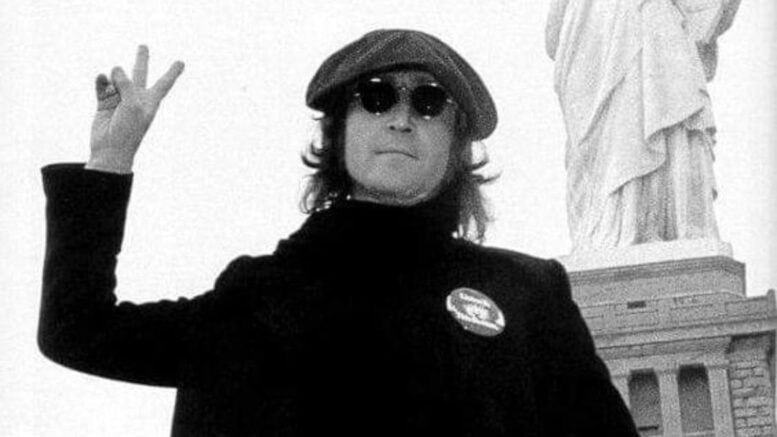
Later that year in 1971, John and Yoko moved to New York City’s Greenwich Village, seeking a new network with political activists and avant-garde artists. They teamed up in a concert with activist Jerry Rubin advocating for the freeing of John Sinclair, who was in jail for the possession of marijuana. The concert was a success, and Sinclair was reunited with his family shortly after. Eventually, John fell out with Jerry Rubin after Rubin stated that radicals should riot during the Republican convention. In June of 1972, John released Some Time in New York City, which consists of live performances of politically charged songs that tackle sexism, incarceration, racism, and imperialism. The album was a commercial flop, but John’s attempt to position himself as a working-class hero did not go unnoticed by the powers that be. John’s activism got him in trouble with Nixon, specifically because of John’s support for anti-war presidential candidate George McGovern, and his donations of over 70 thousand dollars to family members of those killed by police during the Attica state prison uprising. His phones were tapped, over 500 pages of FBI files were gathered on him, and he was given an ultimatum to leave the US in 60 days or face deportation. The fight for residency went on for three years until it was finally granted in court in October of 1975, with his green card issued in July of 1976.
After the public feud from two years earlier, fans speculate that John and Paul continued communicating through their albums. There’s a line in John’s 1973 song “I Know,” that reads, “And I know it’s getting better all the time, as we share in each other’s mind.” The line “It’s Getting Better All The Time” is the refrain from the song Getting Better on the Sgt Pepper album, written by Paul. Another line in the song is “today, I love you more than yesterday,” which might sound like a generic love sentiment that could just as easily be applied to Yoko, but remember that John’s attack on Paul a few years earlier in “How Do You Sleep?” was the line “The only thing you done was Yesterday.” Perhaps this was John’s way of apologizing for how he behaved toward his friend? We’ll never know, since John dismissed the song as “just a piece of nothing.”
During this time, his marriage with Yoko was becoming strained, due to two primary reasons. The first was after Nixon was reelected, they went to a party at Jerry Rubin’s apartment, where John got drunk, and cheated on Yoko in the next room with Jerry Rubin’s roommate. Everyone in the living room, including Yoko, could hear everything. Yoko claims that she tried to forgive him, but that something was irrecoverably lost. Also, she had trouble coping with being hated by so many people, including the press. Even though she pursued John because of his influence, and hoped that others would see her as a creative equal, she was now ambivalent with all the stress and criticism that came with living under his shadow. She and John agreed to a separation, with mutual freedom, and told her assistant, May Pang, to become John’s girlfriend. Pang was originally shocked and said no, but Yoko insisted.
John produced Nilsson’s album Pussy Cats, and Elton John played piano on John’s song, Whatever Gets You Through the Night, one of the most recognizable songs on his next album Walls and Bridges.
Paul alleges that he spoke to Yoko during their separation, and that she told him that even though she still loved him, John would have to work his way back to being with her. Seeing that John was falling back into alcoholism and substance abuse while in LA, Paul helped John reconnect with her, and much to May Pang’s discontent, John told her, “She’s allowed me to come home.” There are accounts by May Pang that John was going to start writing with Paul again. Allegedly when Yoko heard about this, she decided to allow John back into her life. It’s hard to know what Yoko’s true motivation was for taking John back, but according to Pang, John continued to see her romantically without Yoko’s knowledge.
His last public appearance was in 1975, when John performed for a tribute to British media mogul Lew Grade. He appeared in a red jumpsuit, performing Slippin and Slidin’, Stand by Me, and Imagine. Six months later, Sean Lennon was born on October 9, sharing John’s birthday. Sean gave John a renewed sense of meaning in life, and John decided to take an indefinite hiatus from music, feeling disillusioned with the industry. There are accounts of him being a house husband, changing diapers, and learning to cook and bake bread, and other accounts that John spent much of his time in his room watching TV or reading, with hired nannies taking care of Sean. But there is no doubt that in the first five years of his life, Sean was able to spend more time with his father than his older brother Julian ever did. Five years after Sean’s birth, on a trip in Bermuda in 1980, John experienced a new surge of creativity, prompting him to go back into the studio and record his final album. When Yoko found out about his return to music, she insisted on it being a double album that would alternate between her songs and John’s, hence the title, Double Fantasy. Well known songs of his on the album include Woman, (Just Like) Starting Over, and Watching the Wheels. He also wrote a heartfelt song dedicated to his son Sean, called Beautiful Boy.
The overall theme of the album seems to be that of John looking forward to how the rest of his life would unfold. Tragically, as we know, that promise of a better future was broken less than a month after the release of the album. On December 8th, 1980, John was approached for an autograph by a man with a copy of Double Fantasy. John generously obliged. Five hours later, returning home from the recording studio, the same man, Mark David Chapman, called out his name, and shot him twice in the back, and twice in the shoulder. John was pronounced dead shortly after arriving at the hospital, and when the police arrived, Chapman was arrested without a struggle. He has appealed for parole every year since 2000, and each year his appeals have been rejected. Friends and fans from all over the world were heartbroken and shocked that John, who advocated so fervently for peace, died so suddenly in such a senseless act of violence.
Yet, his musical legacy is a gift that keeps giving. Strawberry Fields in Central Park is a memorial that was set up by Yoko as a “living monument” that keeps his memory alive. Fans and performers still gather daily to celebrate his music with the Beatles, and after the Beatles. A posthumous album was released in 1984, Milk and Honey, also a joint endeavor between him and Yoko, featuring John’s songs “Borrowed Time” and “Nobody Told Me.” Three of John’s unfinished demos were completed by the remaining Beatles during two different periods. Free As A Bird and Real Love were completed in 1995 by Paul, George, Ringo, and producer Jeff Lynne, and Now and Then was completed in 2023 by Paul, Ringo, and Giles Martin, son of The Beatles’ producer George Martin.
John is considered a legend not just due to his activism for peace, or just because of his timeless melodies and powerful lyrics. He’s also a legend because of his ability to embody the full range of a multifaceted human being, including joy, pain, tenderness, aggression, insecurity, and wit. He reminds us that it’s okay to feel flawed or broken, as long as we believe in our own potential to move in the right direction.