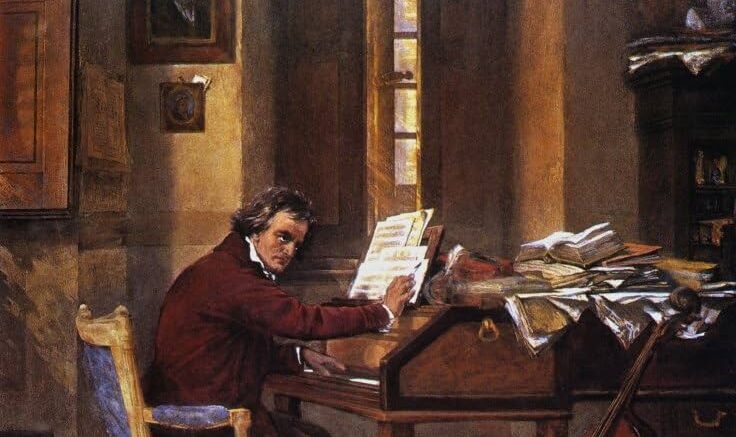
As you may know, Beethoven’s final symphony, the 9th, is the first time in history that voices appear as part of a symphony. It’s twice as long as other symphonies written up until that time, lasting a full hour. In the finale, he set to music Schiller’s poem “Ode to Joy”.
Beethoven’s Ode to Joy was heard during the protest demonstrations on Tiananmen Square in 1989. It is sometimes performed to mark the grand opening of a new concert hall, at the opening of the United Nations General Assembly, and every New Year’s in Japan, it is sung by a chorus of 10,000 singers!
Gregg Wolpert wrote: “Johann Friedrich von Schiller wrote his poem “Ode to Joy” in 1785. The poem contains Schiller’s conviction in the family of humankind, the equality of all people, and the desire for everyone to lead a happy and peaceful life.
It is the official anthem of the European Union. After the fall of the Berlin Wall on October 3, 1990, more than 1 million Germans gathered to sing “Ode to Joy” to celebrate German reunification. The important message is that we are all brothers and sisters, equal, and should not be subject to ridicule or tyranny by those in power. Let us embrace friendship and gratitude, and reject violence, hate, and bigotry of all kinds, and share in the spirit of the oneness of humanity and equality of all humankind.”
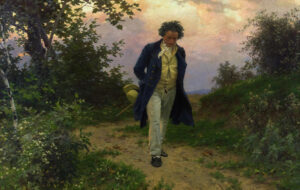
Beethoven started out in life with perfect hearing, but began gradually losing it when he was in his late 20s. Eventually, he became completely deaf. Yet he continued composing to the end of his life, imagining the music in his mind’s ear.
My mentor, the Buddhist philosopher Daisaku Ikeda, wrote: “In his late 20s, Beethoven began to be plagued with a ringing in his ears and abdominal pains. Gradually, his hearing began to fail. Bravely, he resisted this tragic destiny, declaring, ‘I shall seize fate by the throat!’
He eventually became completely deaf. When he realized that his hearing would never return, he became incredibly depressed, and thought of committing suicide.
Ikeda wrote, “It was a struggle with one’s destiny, while at the same time, striving to impart courage to others. At the height of his career, he experienced a serious slump, composing very little for several years.
Ikeda, ”He felt that his art should be dedicated to the poor–an extremely revolutionary way of thinking for a musician in those days. And it was an attitude and way of life that brought him much financial hardship.”
The conductor Wilhelm Furtwängler said the beginning of the 9th Symphony is “the sound of the universe that has been resonating since the beginning of time.”
And Thomas Knapp painted a depiction of the 9th Symphony.
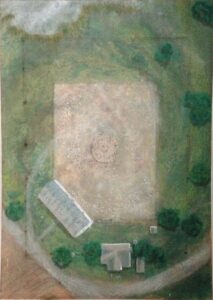
He said: “For me, the Ninth Symphony depicts the evolution of life from the beginning of the universe, continuing through the epic process of forming galaxies and solar systems, eventually to forming Earth, culminating in humans and ultimately to the state where humans live harmoniously together as one family.
As a visual artist, I see the starting point of the symphony as if in a dark abyss. Then, from seemingly empty space, little vibrations begin to pulse with life. At first one, then another, then more, until many are teaming together. This life, at times, chaotic, is at other times, growing and powerful.
In later movements, I see the dynamism of the music as Life springing from the earth in abundance and diversity. The symphony seems to recount this part of earth’s history, as if in time-lapse, where millennia are condensed into mere moments.
My challenge was how to represent the 4 movements in one painting, or even a series of paintings. It was for this reason I needed to understand the true essence of what Beethoven was trying to communicate.
But even when I felt confident in this regard, what images could I use?
The first inspiration for my painting came from the Um-Pah, or very folkish sounds just before the start of the tenor solo. I know that Beethoven wrote his music specifically for the common people. As a result, the image of a folk dance, in the form of a circle came to me. Seen from an aerial perspective, this would represent the unity of humans, which the chorus proclaims.
The next inspiration came to me when I wanted this unity to feel like an all-encompassing force, like the force of gravity. At that moment, I realized that the aerial view should be of a country fair, where the folk dancers are situated in the center, and other people branch out from them in a swirling pattern, just like our Milky Way Galaxy. These elements would combine the microcosm of the people, and the macrocosm of the universe into one image, which I felt captured the energy and message of the symphony.
The composition of the fields and buildings are based on the farm where my mother grew up in southern Illinois.
I used a splatter paint technique, like Jackson Pollack, to bring visual energy to the center of the composition.
I likewise used the pinwheel composition, so often used by Rubens, to create a sense of explosive power.
The repetition of rectangles, the same proportion as the frame of the painting, radiates this energy outward again.
I still need to add more detail to the people, which I continue to work on, to complete the painting.”
I am absolutely overwhelmed by the incredible Aurora Orchestra from England, and its founder and conductor, Nicholas Collon. They play entire symphonies, including Beethoven’s 9th, entirely from memory, while standing!
In 2024, to mark the 200th anniversary of Beethoven’s Ninth Symphony, they performed it at the Royal Albert Hall in London, preceded by a theatrical presentation highlighting many passages of the symphony, as well as vignettes from Beethoven’s life, featuring actors representing Beethoven’s nephew Karl, his assistant Anton Schindler, his doctor, and the deaf Beethoven himself, played by an actress who also happens to be deaf. The dialogues were taken from the 139 surviving Conversation Books, which document the conversations Beethoven had after losing his hearing. The actors were Rhiannon May and Tom Simper. The conductor was the Aurora Orchestra’s Founder, Nicholas Collon.
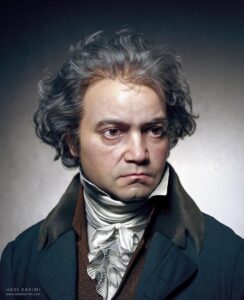
In 1937, the conductor Arturo Toscanini wrote to his mistress about the third movement: “I am deeply into the Ninth Symphony. The Adagio! Elysian Fields, Paradise, I feel what is inexpressible. It lifts me off the Earth, removes me from the field of gravity, makes me weightless; one becomes all soul. One ought to conduct it on one’s knees. Do you know that at the modulation to E flat I always conduct with my eyes closed? I see extremely bright lights far, far away; I see shadows moving around, penetrated by rays that make them even more disembodied; I see flowers of the most charming shapes and colors. And the very music I’m conducting seems to descend from up there, I don’t know where! It’s all a mysterious spell that wraps around me during those 16 bars, and it changes at the next modulation into the main key, when the second divine variation begins. The picture, the landscape is transformed, but it’s still another small part of the Elysian Fields. From this you can imagine the life I’m leading on the little island.”
Daisaku Ikeda wrote: “At age 22, he was already making an attempt to set the Ode to Joy to music. But it took more than 30 years before the poem and melody were finally fused in the choral finale of the Ninth Symphony.
“The vibrant voices of Ode to Joy in Beethoven’s Ninth Symphony transport the listener to a higher spiritual plane that is majestic, sublime and solemn. Enveloped in joy, all discrimination disappears; with universal friendship as the core, all people are bound together as members of one human family. They join in lively celebration, until the joy reaches almost celestial heights as the finale approaches it’s climax.
“When Ode to Joy made its debut, freedom and democracy were out of favor in Vienna, as resentment ran high over the Napoleonic wars. The music of the 9th is perhaps symbolic of the revolution taking place in the hearts of the common people, who, having now become the masters of their destinies, sever the heavy chains of earthly misery to rise high into the boundless skies of the spirit. The Ninth Symphony represented a light of freedom and democracy, penetrating the darkness of the age. It was a tribute to spiritual courage, a symphony dedicated to all humanity. The clouds of torment and anguish could not obscure the vast blue skies of his inner spirit.”
The conductor Benjamin Zander called Beethoven’s 9th “a glorious shout of universal joy.”
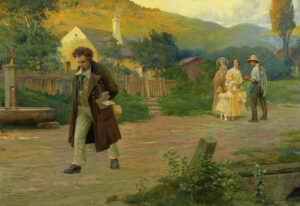
Daisaku Ikeda wrote, “The 9th Symphony is a tribute to the triumph of spirit that expresses Beethoven’s whole stormy life; it is a hymn to the sanctity of the human spirit. Beethoven’s 9th Symphony is the roar of the spirit of that great musical genius, who proclaimed: “At the end of suffering, there is joy!’
“One of Beethoven’s last letters contain words that actively sum up his entire life and being: they are ‘joy through suffering’.
“A person’s true greatness lies in challenging and overcoming life’s hardships; doing so, represents a triumph of humanism. And the source of that triumph is joy. As we brave the fierce storms of life, the light of joy will illuminate both ourselves and the world around us with a rich golden hue.”
Ikeda felt that Beethoven’s Ninth Symphony, a masterwork of joy attained through vanquishing sorrow, was, in a sense, an expression of a profound Buddhist principle. He described music as “a vitalizing power, capable of inspiring courage and rekindling hope and transcending barriers between people”. Ikeda asserted the true essence of music lies in its ability to touch the human soul.