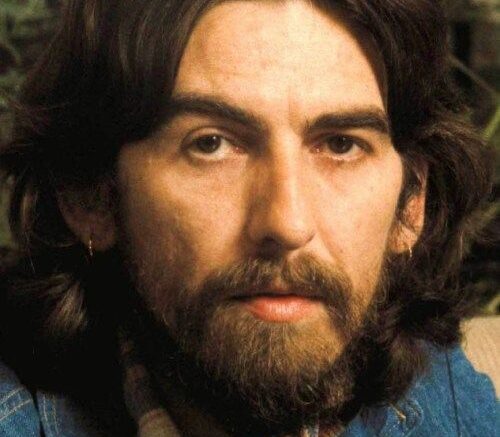
By Michael Laster
George Harrison was born to Harold and Louise Harrison on February 25th, 1943, in Liverpool, England. Harold was a bus conductor, and Louise was a shop assistant.
George was the youngest of four – he had two brothers and a sister. His early childhood and home life were ideal, with both parents offering unconditional love and support. According to his friends, George, as a child was curious, well–behaved, and had a full-spirited sense of humor, in spite of his shyness. He also had a mischievous side. After passing his exams, he entered the prestigious Liverpool Grammar School, which was known for its strictness. On one occasion, George was physically punished by a teacher and came home with welts on his wrist. His father then took matters into his own hands.
He started developing a strong rebellious streak against authority around this time, manifesting in a hatred of school and the dogmas of Catholicism. Around 1956, rock-and-roll entered onto the world stage, and thirteen-year–old George turned all his energy and focus towards his new acoustic guitar. Not only did he learn the music of Elvis and Chuck Berry, but he also developed a love of country guitarists like Chet Atkins and Gypsy Jazz legend Django Reinhardt.
That same year, he met Paul McCartney on the school bus, who was nine months older than him. They quickly formed a bond through their love of music, and soon ended up hitchhiking together to South Wales.
In July of 1957, Paul met John Lennon, the leader of a band called The Quarrymen. Paul joined immediately and persuaded John to let George join in early 1958. When George left the Grammar School at age 16, he got an apprenticeship as an electrician’s assistant, but according to him, he “kept blowing things up, so I got dumped.”
For the next two years, the Quarrymen performed various concerts around Liverpool, until one day, they got an offer from their manager Alan Williams to play in Hamburg’s red light district, the Reeperbahn. They recruited John’s friend Stu on bass and Pete Best on drums.
George’s days of Liverpool innocence quickly came to an end, as he and the rest of the band gained experience with amphetamines, women, and playing on stage for up to eight–hour sets. But once the authorities found out that George was underage, he was deported, and the party soon came to an end. Stu Sutcliffe left the band in 1961, and Paul took over on bass. Over the next two years, they’d return to Hamburg, in addition to being the headliners of the Cavern Club back in Liverpool. Around this time, their new manager, Brian Epstein, got them an audition with Decca Records.
After failing to get a contract with Decca, they auditioned for Parlophone, headed by producer George Martin. Martin didn’t like Pete Best’s drumming on Love Me Do, and it was Harrison who suggested they fire Pete and replace him with Ringo Starr, whom they were familiar with from their days in Hamburg. The firing of Pete caused one of his fans to give George a black eye, which can be seen in pictures from 1962 from The Beatles’ first recording session.
In the very early days of the Beatles, George was more interested in developing his guitar skills than being a songwriter. On their debut album, Please Please Me, George sings lead on Do You Want to Know a Secret, written for him by John. His first attempt at songwriting showed up on their second album, With The Beatles, with his song, Don’t Bother Me. It’s a glimpse into a type of bitterness that would show up in his lyrics for the rest of his life.
For the album, A Hard Days Night, George sang I’m Happy Just To Dance With You, written by John and Paul, and for the Beatles For Sale album, George sang the Carl Perkins hit, Everybody’s Trying To Be My Baby. On the album Help!, he contributed two new songs, You Like Me Too Much, and I Need You, the latter written for the model Patti Boyd who he met on the set of A Hard Day’s Night. They married in January of 1966.
Like John, George was quick to grow weary of the cult of Beatlemania. A somewhat private person by nature, he didn’t like the lack of privacy, and the security concerns that came with fame. He preferred to be valued and respected as a guitarist than be worshipped as a pop star by screaming young women. One photo captures him throwing water at a photographer who snuck into a night club.
In addition to his hangups about stardom, he was also growing weary of getting the cold shoulder by John and Paul whenever he showed them his songs. They were his closest friends, but there also existed a clear hierarchy within the band, with John and Paul on top. While they would help George with his songs when asked, they were in no rush to help him become an equal. As a guitarist, George wasn’t particularly virtuosic, but his solos were a perfect fit for the raw, yet melodic sound the Beatles were known for. His trademark was often a tastefully embellished version of the main melody, like the solo to John’s Nowhere Man. George was also the first guitarist to popularize the sound of the 12– string electric guitar, which was soon adopted by the Byrds for Mr. Tambourine Man and Turn Turn Turn.
Two major events happened in 1965 that would shape the rest of George’s life. He and John and their wives were at a dinner party hosted by their dentist, John Riley, who spiked their drinks with LSD. For the first time, he felt like he was perceiving reality the proper way, feeling connected to everything around him without the layer of ego.
The second time he and John did LSD was in Beverly Hills with Roger McGuinn and David Crosby of the Byrds. Crosby started talking about the music of Ravi Shankar, and George bought his albums shortly afterwards. When he listened to these records of Ravi Shankar, a lightbulb went off in his head. Shankar’s sitar playing connected music with the deep spiritual insights that George experienced on LSD. He quickly bought a cheap sitar from a music shop in London, which he used on the Beatles’ next album, Rubber Soul, and John asked George to play the instrument on his song Norwegian Wood. On the album, George contributed two songs – If I Needed Someone, a straightforward love song, and Think For Yourself, which showcases George’s growing sophistication as a musician and lyricist.
This growing sophistication continued with the three songs he contributed to their next album, Revolver. These songs were Taxman, Love You, Too, and I Want To Tell You, which all express some aspect of disillusionment with a different subject:
- Taxman is about his frustration with the Labour government’s taxation policy, with various lyrical contributions by John, and musical contributions by Paul, such as the bass line and guitar solo.
- I Want To Tell You is about George’s frustration in putting his thoughts and feelings into words.
- Love You, Too is a love song that also disparages the “people standing ’round who’ll screw you in the ground, They’ll fill you in with all their sins.”
It features Indian instruments like the sitar, tabla, and tambura. It is a matter of debate whether George or a session musician is playing sitar, though it is most likely George. Shortly after recording the song, George met Ravi Shankar, who agreed to take him on as a student, noticing George’s dedication and humility.
The Beatles stopped touring in 1966, with George’s safety concerns being one of the main reasons. He flew to India later that year to officially study with Shankar. He said “My hips were killing me from sitting on the floor, and so Ravi brought a yoga teacher to start showing me the physical yoga exercises. It was a fantastic time. I would go out and look at temples and go shopping. We travelled all over, and eventually went up to Kashmir and stayed on a houseboat in the middle of the Himalayas. It was incredible.”
On their next album, Sgt. Pepper’s Lonely Hearts Club Band, George only had one song, Within You, Without You. Not only are the lyrics some of his most philosophical, but the arrangement written by George Martin seamlessly combines Western and Indian classical traditions, making it one of the highlights of the album.
Unlike other rock musicians, Harrison wasn’t dabbling in Indian music for an exotic effect. He was immersed in it, potentially making this track the peak of the 60’s counterculture’s fascination with Indian music. George became the main figure in pop culture responsible for introducing the sitar and Indian philosophy to Western audiences. He also wrote a tongue-in-cheek number for Sgt. Pepper called It’s Only A Northern Song that didn’t make the album, but ended up on the soundtrack to the Yellow Submarine film.
Later that year, his wife Pattie, who was also interested in Eastern spirituality, read about Maharishi Mahesh Yogi in a newspaper advertisement. She, George, John, and Paul attended a lecture he gave in London. Fascinated with the prospect of what Transcendental Meditation had to offer, they attended another conference by the Maharishi in Wales, where they got news that their manager Brian Epstein had died of what appeared to be an accidental overdose of sleeping pills. They meditated with the Maharishi a few days after Brian’s death, and several months later, they participated in his intensive retreat in India.
George contributed two more songs that year, It’s All Too Much, and Blue Jay Way. At the start of 1968, George flew to India to record experimental music for the avant-garde film Wonderwall, and released an album of the music. He later returned to India with the other three Beatles and their partners for the Maharishi’s retreat in Rishikesh.
On George’s 25th birthday, a celebration was held at the retreat. The Maharishi gifted Harrison an upside-down globe, exclaiming, “George, the globe I am giving you symbolizes the world today. I hope you will help us all in the task of putting it right.” George turned the globe over and said “I’ve done it!” Which received laughter and applause by the guests.
He spent another two months in India until word got around that the Maharishi was making advances on some of the women there, namely Mia Farrow. It is unknown whether the allegations were true, but John and George left shortly after. John wrote a song called Maharishi about the experience, but Harrison urged him to change the four syllables to Sexy Sadie. George also appeared in the film Raga, a film that documents Ravi Shankar’s life and influence in the West. There’s also footage of Ravi with the classical violinist Yehudi Menuhin.
Once all 4 Beatles were back in London, they got to work on The White Album, for which George contributed four new songs, none of them containing any Indian influence. They are: Piggies, Long, Long, Long, Savoy Truffle, and the masterpiece, While My Guitar Gently Weeps. Because of the tensions stirring in the band, partially due to John’s insistence of having his newest partner – Yoko Ono – sitting in on sessions, George brought in his friend Eric Clapton to help keep the other three on their best behavior.
In turn, George played rhythm guitar on Clapton’s song Badge, which Clapton wrote for his band Cream, appearing on the album Goodbye Cream. They struck up a friendship back in 1964 when Clapton was still with the Yardbirds, and it grew from there, especially after Clapton gifted George a Les Paul guitar, which Clapton ended up playing on While My Guitar Gently Weeps. Clapton initially refused. According to George, “I said ‘Look, it’s my song and I’d like you to play on it.’ So he came in. I said, ‘Eric’s going to play on this one,’ and it was good because that then made everyone act better. Paul got on the piano and played a nice intro and they all took it more seriously.” George also produced the artist Jackie Lomax during this period, writing the song Sour Milk Sea for him.
During the Let It Be sessions, George left the band. He casually wrote in the diary that day, “left the Beatles”, and John flippantly proposed getting in Eric Clapton to replace him. This seems a bit cold, but in a leaked conversation shortly after the incident, it’s clear that John does have empathy for George’s situation within the Beatles, and how he and Paul’s egos have contributed to him feeling sidelined.
George returned five days later after the others agreed to change recording studios to a different location that he, George, preferred. Like he did with Eric Clapton, George brought in the keyboardist Billy Preston to help keep the band on their best behavior. The mood lightened up instantly, with Preston contributing significantly to the album. For the Let It Be sessions in 1969, George wrote I Me Mine, For You Blue, and Old Brown Shoe, the latter containing some of his best guitar work, in addition to his trademark use of what are called augmented and diminished chords.
It was during these sessions that George became involved in the Hare Krishna movement. At first, members of the movement hung out inside the Beatles’ business headquarters, and their insistence on chanting praises for the deity Krishna proved to be just what George was looking for after his disillusionment with the Maharishi. He helped produce the Hare Krishna mantra that summer.
For the Beatles’ next and final album, Abbey Road, George wrote two of his most famous contributions in his time with the Beatles: Here Comes The Sun, and Something. These were two songs that were not only his best within the Beatles, but were two of the strongest songs on the album, which is no small feat given that the album is often considered one of their best. Here Comes The Sun is notable for the use of odd time signatures, mixing up groups of threes and twos in the “sun, sun, sun – here it comes” section, most likely influenced by Indian rhythms. His song Something has one of his greatest guitar solos, which, when one listens closely, is actually a fantastic duet between bass and guitar.
Frank Sinatra called it one of the greatest love songs written in 50 or 100 years. Even though most assume it was written for his wife, insiders allege that it was dedicated to his newfound love of Krishna. According to George in 1976, “all love is part of a universal love. When you love a woman, it’s the God in her that you see.”
Shortly after finishing the album, John quit the Beatles. Paul announced his departure shortly afterwards, due to not wanting to be managed by Allen Klein, who continued managing the other three. George would shortly go on tour with the American husband-and-wife duo, Delaney and Bonnie, along with Eric Clapton. Eric played lead guitar, and George played rhythm guitar. It was still against his nature to be the center of attention on stage.
In an interview several months later, the reality of the Beatles’ breakup still hadn’t fully set in. “I certainly don’t want to see the end of The Beatles. And I know I’ll do anything, you know. Whatever Paul, John, and Ringo would like to do, I’ll do it. As long as we can all be free to be individuals at the same time.”
After the break-up, George and Pattie moved into Friar Park, a neo-Gothic mansion located between London and Oxford. For the rest of his life, it served as his sanctuary, and he worked on renovations for years, inviting friends and visitors to help out. During this period in early 1970, George helped Ringo write his hit, It Don’t Come Easy.
George soon began work on his first post-Beatles album, All Things Must Pass. He hired Phil Spector as producer, and it consisted of 3 LPs, the first two consisting of 18 songs, many of them written during the Let It Be sessions in early 1969.
The third disc largely consisted of jams with Eric Clapton, Billy Preston, Ringo, Ginger Baker of Cream, and other friends. The album is generally considered his best, the benchmark that all his future albums are compared to, and is also considered by many critics to be the best of the first post-Beatles solo albums, superior to John’s Plastic Ono band album, and Paul’s self–titled album, McCartney. George knew that Clapton was generally a superior lead guitar player, though George had recently reinvented himself as a guitarist, now playing with a slide. Slide guitar became his signature sound for guitar solos from this album forward. The opening track, I’d Have You Anytime, was co-written by Bob Dylan, who helped with the lyrics of the chorus. Eric Clapton plays lead guitar. The song Wah-Wah was written after an argument during the Let It Be sessions. The lyrics about renouncing negativity and embracing freedom aptly feature Eric Clapton using a wah-wah pedal. The song, Isn’t It A Pity, is a heartfelt lament about how we often overlook the feelings of others. George also included a top–notch cover of Bob Dylan’s, If Not For You.
The song, Beware of Darkness, warns of various things that lead people in the wrong direction, and features some of his most interesting chord changes rarely heard in rock music. The song, My Sweet Lord, from the album remains George’s best-selling single of all time. It was also the subject of an infamous lawsuit, but we’ll examine that in part 2, in addition to some of his lesser-known work after the Beatles, his success with the all-star group, The Traveling Wilburys, the attack on his life in 1999, and his final album, Brainwashed.