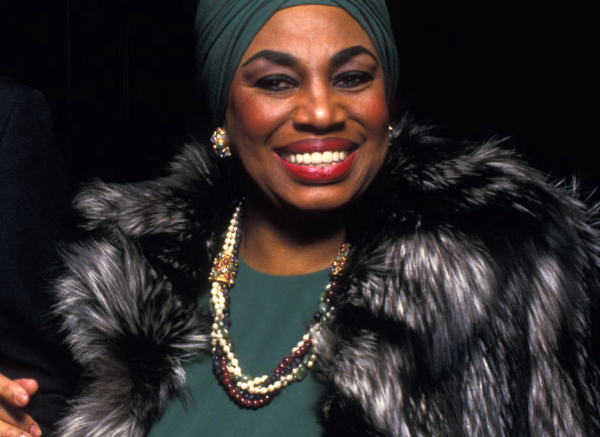
Leontyne Price
The soprano Sissieretta Jones was born in 1868 in Virginia. By 1895, she had become the most well-known and highly paid African-American performer throughout the world. Jones sang for the British royal family and for four US presidents, but was forced to enter the White House through the back entrance. There are no recordings of her voice.
Marian Anderson was born in Philadelphia in 1897. She was denied admission to the Philadelphia Music Academy because of her race. In 1925, as a competition winner, Anderson performed with the New York Philharmonic, but racial prejudice prevented her career from gaining momentum. In 1930, she met the composer Sibelius, who was so moved by her singing that he altered and composed songs for Anderson. Arturo Toscanini told her she had “a voice heard once in a hundred years”. Although she gave approximately 70 recitals a year in the United States, Anderson was still turned away by many hotels and restaurants. Because of this, Albert Einstein, a champion of racial tolerance, living in exile in Princeton, hosted her on many occasions. In 1939, she was barred from singing in DAR Constitution Hall in Washington D.C. As a result, Eleanor Roosevelt and President Roosevelt arranged for Anderson to perform at the Lincoln Memorial, for an audience of 75,000 people, and heard on the radio by millions. In 1955, Anderson became the first African-American to perform at the Metropolitan Opera. She worked as a delegate to the United Nations Human Rights Committee, and as a goodwill ambassador for the State Department touring the world. She sang at the historic march on Washington in 1963, and at the inaugurations of Presidents Eisenhower and Kennedy. Anderson was awarded the first Presidential Medal of Freedom, the Congressional Gold Medal, the Kennedy Center Honors, the National Medal of Arts, the Grammy Lifetime Achievement Award, the United Nations Peace Prize, New York City’s Handel Medallion, and was the recipient of 24 honorary doctorate degrees. She died in 1993 at the age of 96. Her music studio is now a museum in Danbury, Connecticut, the house of her birth in Philadelphia is part of The National Register of Historic Places and there is a United States postage stamp bearing her image. She established the Marian Anderson Award in 1943, which continues to award $25,000 each year to an established artist who exhibits humanitarian leadership.
Todd Duncan was born in 1903 in Danville, Kentucky. He received a Bachelor’s degree from Butler University, and a Master’s degree from Teachers College, Columbia University. He was Gershwin’s personal choice for the world premiere of Porgy and Bess, and sang the role of Porgy more than 1,800 times. In 1945, he was the first African-American to sing with a major opera company: the New York City Opera. Duncan taught at Howard University while touring as a soloist. He sang over 2,000 performances in 56 countries. Duncan was the recipient of several awards and two honorary doctorates. He died in 1998 at the age of 95.
Anne Brown was born in Baltimore in 1912. She trained at Morgan College, and after being rejected from the Peabody Institute due to her race, at 16 she became the first African-American singing student to be admitted to Juilliard. She sang the world premiere of Porgy and Bess in 1935, and in the Gershwin biographical movie, Rhapsody in Blue. Her singing career was cut short due to asthma. In 1998, Brown received the George Peabody Medal from the Peabody Institute, the same institution that denied her admission 70 years earlier. She was also made an honorary citizen of Baltimore, and was awarded The Arts Council Norway Honorary Award. She lived in Oslo until her death in 2009 at the age of 96.
Martina Arroyo was born in New York City in 1937. She studied piano with her mother, earned her bachelor’s degree from Hunter College, became a high school English teacher, and then a social worker. In 1958, she won the Metropolitan Opera’s “Auditions of the Air” and made her Met debut in a small role in 1959. She then moved to Europe where she also sang small roles, but eventually she became a leading soprano all over the world. She is a recipient of the Opera Honors award from the National Endowment for the Arts, and is a Kennedy Center honoree. After her retirement from singing in 1989, Arroyo taught at several universities, and has judged competitions, and given master classes internationally. She served on the National Council of the Arts and the Board of Trustees of Hunter College and Carnegie Hall, is a fellow of the American Academy of Arts and Sciences, and is the founder of the Martina Arroyo Foundation dedicated to the development of young opera singers.
Grace Bumbry was born in 1937 in St. Louis, Missouri. She studied at Boston University, Northwestern University and at the Music Academy of the West in Santa Barbara with the great Lotte Lehmann. In 1958, she was a winner of the Metropolitan Opera National Council Auditions. She made her operatic debut in 1960 at the Paris Opera, and became a member of the Basel Opera in Switzerland. At age 24, she became the first black singer to appear at the Bayreuth Festival. At the end of her first performance there, the audience applauded for 30 minutes – resulting in 42 curtain calls. Bumbry is the recipient of several honors and international awards. A long-time resident of Switzerland, she now lives in Salzburg. At the Kennedy Center honors, Aretha Franklin narrated the tribute to her:
Morris Robinson was born in Atlanta in 1969. He received a scholarship to play college football for the military school, The Citadel, in Charleston, SC, where he earned his Bachelor’s degree, and where he was a 3-time All-American offensive lineman. He then became a sales rep for Exxon and the 3M company for 10 years, making 6 figures a year. But he was very unhappy. At 30, he decided to continue his education at the New England Conservatory, and made his debut with the Boston Lyric Opera, and was a member of the Metropolitan Opera’s Lindemann Young Artist Development Program. His Met debut was in 2002, and he has enjoyed success throughout the world with the largest opera companies and symphony orchestras. He was named “Artist-in-Residence” with the Atlanta Symphony, and Artistic Advisor of the Cincinnati Opera. He is the recipient of an honorary doctorate from The Citadel, and was named Artist-in-Residence at Harvard University.
Denyse Graves was born in 1964 in Washington DC. She studied voice at the Oberlin and New England Conservatories, and received further training at the Wolf Trap National Park for the Performing Arts, and the Sarah and Ernest Butler Houston Grand Opera Studio. Graves made her Met debut in 1995, and performed at the second inauguration of George W. Bush. She has sung the world premieres of several contemporary operas, and her recording of We Shall Overcome was sent to space on the NASA’s Orion spacecraft. In 2020, Graves sang at the US Capitol as Ruth Bader Ginsburg’s casket was “lying in state”. She’s a recipient of the “Ambassador of the Arts” award by the Washington Performing Arts, and the Golden Plate Award from the American Academy of Achievement.
Limmie Pulliam, a native of Missouri, attended the Oberlin Conservatory, and participated in the young artist programs of the Cleveland Opera, Opera Delaware and Opera Memphis. He is the winner of several competitions, but Pulliam grew “disenchanted,” with the scene, especially for black musicians, and went on hiatus from singing. After 12 years, he rediscovered his love for music, and successfully returned to performing and competing. I was flabbergasted when I first heard him.
In 2021, he made his L.A. Opera debut, and has sung with several opera companies and symphony orchestras throughout the United States. In 2022, he made his debut with the Cleveland Orchestra singing Otello. He made his highly successful Met debut not long after, in Aida.
Angel Blue was born in 1984. In high school, she studied piano and voice, received her bachelor’s from the University of Redlands, a master’s degree from UCLA, and was a member of the Los Angeles Opera’s Young Artist program. She has performed leading roles all over the world, and is the winner of several competitions. She made her Met debut in 2017, and in 2020, she starred in Porgy and Bess there. She is the first black woman to sing the role of Mimi in La Boheme at La Scala. Angel Blue has sung to raise funds for housing projects for Haitians who have relocated to the Dominican Republic. And in 2014, Blue sang in the annual AIDS Gala in Dusseldorf, Germany, raising $142,000 Euros to help those affected by AIDS and HIV in Germany and South Africa.
Simon Estes was born in Iowa in 1938. His grandfather was enslaved and sold at auction for $500. Estes attended the University of Iowa and the Juilliard School. In 1965, he made his opera debut in Berlin, and won the bronze medal at the International Tchaikovsky Competition in Moscow, after which, President Johnson invited him to perform at the White House. In 1978, he became the first black man to sing a leading role at The Bayreuth Festival where he sang for several years. While his career was flourishing in Europe, American opera companies refused to hire him – except the San Francisco Opera. Finally, in 1982, he made his Met debut, but was warned by Leontyne Price, who had suffered threats to her life when she first appeared at the Met: “Because you are a black male, the discrimination will be greater. You have a beautiful voice, you are musical, intelligent, independent and handsome. With all of these ingredients, you are a threat. It will be more difficult for you than it was for me.” He sang at the Met for several years, including for the Met’s first-ever production of Porgy and Bess in 1985. He has been at the forefront of artists for HIV Aids prevention and education. In 2013, his foundation partnered with the UN to raise funds to eliminate malaria in Africa. He has taught voice at several universities, and is the recipient of many honorary degrees.
Lawrence Brownlee was born in 1972 in Youngstown, Ohio. He had a very musical childhood, playing trumpet, guitar and drums, and singing Gospel music in church. Brownlee attended Anderson University for his undergraduate degree, Indiana University for graduate studies, and participated in The Seattle Opera Young Artists Program and the Wolf Trap Opera Company. His professional debut was in 2002 with the Virginia Opera, and he made his Met debut in 2007. He gives recitals featuring his Spiritual Sketches album with Damien Sneed, and in 2015, he performed the role of Charlie Parker in the world premiere of Daniel Schnyder’s opera Yardbird. In 2018, Brownlee premiered Cycles of My Being by Tyshawn Sorey and Terrance Hayes. It centers on what it means to be a black man living in America today, and in 2020, it was made into a film.
With a young son diagnosed with autism, the song that gives him comfort is All Night all Day Angels Watching over me.
Lawrence Brownlee is the winner of the Met’s Laffont Competition, the Richard Tucker Award, the Marian Anderson Award, the Opera Philadelphia’s Anne d’Harnoncourt Award for Artistic Excellence, and Seattle Opera’s 2008 Artist of the Year. Brownlee is sought after throughout the world as one of the most exciting tenors of the bel canto operas of Bellini, Donizetti and Rossini.
Leontyne Price was born in 1927 in Laurel, Mississippi. She began piano lessons as a young child, and when Leontyne was nine, her mother brought her to a concert by Marion Anderson. It was a life-changing event for her. While in high school, Leontyne began singing professionally at funerals and picnic functions. She then enrolled at Central State College in Wilberforce, Ohio, and was assisted financially by the family for whom she had worked as a maid and babysitter in Mississippi. Leontyne was also assisted by the celebrated bass, Paul Robeson, who sang a benefit concert to augment her scholarship at Juilliard.
While at Juilliard, the composer Virgil Thomson heard her and cast her in his opera, Four Saints in Three Acts in Paris, and for a Broadway run. She then sang the role of Bess in a touring production of Porgy and Bess in the U.S. and, sponsored by the State Dept., throughout Europe. In 1952, she married her Porgy and Bess co-star, William Warfield. They separated in 1967. In 1953, she sang the world premiere of Samuel Barber’s Hermit Songs with Barber at the piano. At age 27, Price made her NY debut at Town Hall, which led to her singing Tosca and the role of Pamina in The Magic Flute on TV. The State Dept. then sent her on tour to India and Australia.
In 1957, Price sang Poulenc’s new opera, The Dialogue of the Carmelites in San Francisco where she also stepped in as a last-minute replacement singing Aida, which she sang for her European debuts at the Vienna State Opera, London’s Royal Opera and at the Arena di Verona in Italy. In 1959, she made her first recording, which won her a Grammy award.
In 1961, the Met invited her to sing 5 operas, including Aida, with which she made her Met debut. Her ovation at the end of the 1st performance was said to be the longest in the history of the Met, and she soon appeared on the cover of Time magazine. In 1966, Leontyne sang at the grand opening of the new Metropolitan Opera House at Lincoln Center, singing the world premiere of Samuel Barber’s Anthony and Cleopatra. The role of Cleopatra was written specifically for her. During her 21 years at the Met, she sang 201 performances of 16 roles. At age fifty-eight, Leontyne Price ended her operatic stage career by singing a farewell performance of Aida at the Met. The applause after her big aria went on and on for several minutes before the performance could continue!
In Sept. of 2001, at age 74, she came out of retirement to sing at a memorial concert for the victims of 9/11 and sang God Bless America, unaccompanied.
Among her many honors and awards are the Presidential Medal of Freedom, the Spingarn Medal from the NAACP, the Kennedy Center honors, the National Medal of Arts, numerous honorary degrees, 13 Grammy awards, and a Grammy Lifetime Achievement Award. The sopranos Renee Fleming, Kiri Te Kanawa, Jessye Norman, Leona Mitchell, the mezzo sopranos Janet Baker and Denyce Graves, and the bass baritone, Jose van Dam, all spoke of Price as their inspiration.