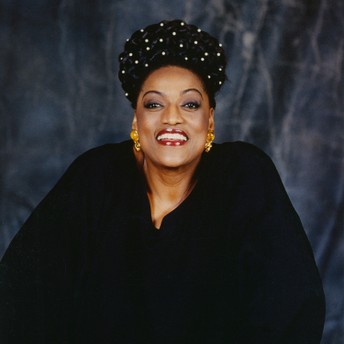
Jessye Norman
Mattiwilda Dobbs was born in Atlanta in 1925. She graduated from Spelman College and Columbia University, and won a number of scholarships to study in Europe. After winning the Geneva International Music Competition in 1951, she sang at the major festivals and opera houses throughout Europe, and was the first black singer to perform at La Scala. Her successful European career set an example to younger black female singers such as Leontyne Price, Shirley Verrett, Jessye Norman, and Kathleen Battle. She was the first black woman to sing a lead role at the SF Opera, and to sing a lead role and be offered a long-term contract by the Met, where she sang for eight seasons. Dobbs taught at Howard University, and was the first African–American on the faculty of the University of Texas. Dobbs served on the board of directors of the Metropolitan Opera, received an award from the NAACP, the Order of the Northern Star from the king and queen of Sweden, and an honorary doctorate from Spelman College. She died from cancer in 2015 at the age of 90.
Leona Mitchell was born in 1949 in Oklahoma. She studied at Oklahoma City University and the Juilliard School. In 1973, she made her Met and San Francisco Opera debuts. She sang the role of Bess in the first complete recording of Porgy and Bess, for which she received a Grammy award. She has sung at most of the world’s best known opera houses and major symphony orchestras. She has performed for many dignitaries, including four US presidents. Mitchell has been awarded many honors and two honorary doctorates. Her hometown of Enid has a street and a museum named in her honor. She was Oklahoma’s state cultural ambassador and has been inducted into the Oklahoma African-American Hall of fame.
Robert McFerrin, Sr. was born in Arkansas in 1921. He is the father of Bobby McFerrin. He studied voice in high school, at Fisk University, and at Chicago Musical College. In 1949, he made his New York City Opera debut. In 1953, he was the first African-American to win the Metropolitan Opera’s “Auditions of the Air”, and was the first African-American male to sing a role at the Met. The following year, he became the first African-American to sing a title role at the Met, where he sang for 3 years, and was the first African-American to sing at both the Met and New York City Opera. He was also the first African-American to sing a title role in Naples at the San Carlo Opera. In 1958, he recorded the role of Porgy for the soundtrack of the movie Porgy and Bess in which Sydney Poitier starred as Porgy. McFerrin taught at the Sibelius Academy in Helsinki, Sacramento State College, and the St. Louis Institute of Music. He has received two honorary doctorates, a Lifetime Achievement Award and is commemorated in the St. Louis Walk of Fame. In 2016, McFerrin died in St. Louis at the age of 85. George Shirley wrote “Robert McFerrin instilled within me and countless other black males the resolve to pursue our Destinies as performers in the profession of grand opera.”
Reri Grist was born in New York City in 1932. She attended The High School of Music & Art, and received her Bachelor of Music degree from Queens College of the City University of New York. In her early teens, she performed on Broadway with Essie Davis and Ruby Dee, and was Consuelo in the original cast of West Side Story. Her operatic debut was at the Santa Fe Opera in 1959, after which she made her debuts at the Cologne Opera,The Royal Opera House – Theatre in Covent Garden, the Glyndebourne Festival Opera, and the Vienna State Opera, where she performed for 25 years. Grist sang at the Salzburg Festival, and at the San Francisco Opera for 12 years, and at the Met for 13 years. From 1965 to 1987, she performed regularly at The Bayerische Staatsoper, Munich, and at the Lyric Opera of Chicago, Deutsche Oper Berlin, La Scala Milano, Teatro Colon in Buenos Aires, the Holland Festival, and the Ravinia Festival. Grist made 11 films, and ended her opera career in 1991.
She has held professorships in voice at Indiana University and at the Hochschule für Musik und Theater München. She has participated in various International juries and has given master classes at several Young Artists programs internationally. Honors include the title of Bayerische Kammersängerin, and a “Lift Every Voice” Legacy Award from the American Opera Association.
Grist lives in Germany. Years after her retirement from singing, her voice was still beautifully intact!
Florence Quivar was born in 1944 in Philadelphia. As a child, she studied piano and voice with her mother, and began singing solos in church by age 6. She attended the Philadelphia Academy of Music, followed by the Juilliard School. She took master classes with Maureen Forrester, won the Baltimore Lyric Opera competition, the Marian Anderson Award and a Grammy award. She made her Met debut in 1977, where she sang more than 100 Performances.
Quivar sang with leading opera companies and symphony orchestras all over the world, has been especially active in rescuing the works of forgotten composers, especially African-American composers, and has been a champion of new music.
Seth McCoy was born in Sanford, NC in 1928. He studied to become a barber while working evenings as a postal clerk for 13 years. After auditioning for the great conductor, Robert Shaw, who cried the first time he heard McCoy sing, he became a soloist with the Robert Shaw Chorale, and appeared with the leading American orchestras and festivals. McCoy made his operatic debut when he was 50 at the Metropolitan Opera and sang the American premieres of several operas. He was a much beloved voice professor at the Eastman School of Music, and was the recipient of several distinguished awards. He was only 68 when he died in 1997
Ja’nai Bridges grew up in Lakewood, Washington. She attended the Manhattan School of Music, the Curtis Institute, and participated in the Young Artist program at the Lyric Opera of Chicago. She considers Denise Graves, Shirley Verrett, Kathleen Battle, and Jessye Norman – at whose funeral she sang – as her inspirations. She has performed at the Los Angeles Opera, the San Francisco Opera, the Washington National Opera, the Kennedy Center and the Metropolitan Opera. She is a winner of the Marian Anderson Award, and two Grammy awards. After the murder of George Floyd, she proposed and led an online panel of black opera singers with the Los Angeles Opera. In March of 2022, she sang with the National Philharmonic in the world premiere of Adolphus Hailstork’s A Knee on The Neck, a tribute to George Floyd.
George Shirley was born in Indianapolis in 1934. He attended Wayne State University, was then drafted into the army, where he was the first black member of The U.S. Army Band and Army Chorus, and was the first African-American music teacher in Detroit high schools. He was the first black singer to win the Metropolitan Opera National Council Auditions, and is the first black tenor to sing leading roles at the Met, where he sang for 11 years. He has sung more than 80 roles. Shirley was a faculty member of the University of Maryland, the Aspen Music Festival and School, and the University of Michigan, where he was Director of Vocal Arts. Shirley was awarded four honorary degrees, a Grammy award, The National Medal of Arts award, and the Lifetime Achievement Award of the National Opera Association.
Shirley Verrett was born in New Orleans in 1931. She trained as a mezzo-soprano at the Juilliard School, and made her debut at New York City Opera in 1958. She made her first recordings and her European debut in Cologne in 1959, and in 1961, she won The Met’s Laffont Competition—previously known as the Metropolitan Opera National Council Auditions. In 1962, she made her debut with the Spoleto Festival in Italy, and appeared in the first televised concert from Lincoln Center. In 1963, she made her debut at the Bolshoi Opera in Moscow, and in 1964, began recording for RCA. She made her Covent Garden debut in 1966 at London’s Royal Opera House, and made her Metropolitan Opera debut in 1968 as Carmen. That year, Verrett was named “New Artist of the Month” by Musical America. The following year, she made her La Scala debut.
In 1973, she made operatic history when she sang both roles of Cassandra and Didon in Berlioz’s epic, Les Troyens at the Met. In 1976, she achieved the rare accomplishment of adding soprano roles to her mezzo–soprano repertoire, such as Tosca and Norma, which was her favorite role. In 1996, Verrett joined the faculty of the University of Michigan. In 2003, her memoir written with Christopher Brooks, I Never Walked Alone, The Autobiography of an American Singer was released and became a national best seller. In it, she spoke frankly about the racism she encountered as a Black person in the American classical music world. For example, when Leopold Stokowski invited her to sing with the Houston Symphony in the early 1960s, he had to rescind the invitation because the orchestra board refused to accept a black soloist. Verrett died at age 79 in 2010 from heart failure. She was the recipient of several honorary doctorates and numerous awards, including Commander of The Order of Arts and Letters award by the French government. The Shirley Verrett award was established at the University of Michigan in 2011.
Eric Owens was born in Philadelphia in 1970, began studying the piano at age 6, and began studying the oboe in junior high school. He earned his Bachelor’s degree from Temple University, and his Master’s degree at the Curtis Institute. He then joined the Young Artist Vocal Academy at the Houston Grand Opera in 1996, and won the Metropolitan Opera National Council Auditions. In the Ring Cycle at the Met and elsewhere, he has sung the roles of Alberich and Wotan, and has sung the lead in Porgy and Bess in several productions, including that of the Met. Owens is in great demand throughout the world for his performances of both the standard repertoire and contemporary operas. He is the recipient of 3 Grammy awards, the Marian Anderson award, Musical America’s 2017 “Vocalist of the Year” award, and the Luciano Pavarotti International Voice Competition. In 2017, the Glimmerglass Festival appointed him as its Artistic Advisor, and in 2019, Owens became the co-chair of the Curtis Institute’s opera department.
Kathleen Battle was born in 1948 in Portsmouth, Ohio. She received her Bachelor’s and Master’s degrees from the University of Cincinnati, where she worked with the great basso, Italo Tajo. Afterward, she taught elementary school music while continuing to study privately. Battle made her professional debut in 1972 at the Spoleto Festival in Italy. She made her operatic debut in 1975 with the Michigan Opera Theater, her New York City Opera debut the following year, and in 1977, made both her San Francisco Opera and Metropolitan Opera debuts.
At the Met, she sang more than 150 performances of thirteen roles. As her status grew, so did her reputation for being difficult and demanding. In 1994, she was fired from the Met for “unprofessional” actions during rehearsals. She is the recipient of an Emmy award, several Grammys, a grant from the Martha Baird Rockefeller Fund, and six honorary doctorates.
Jessye Norman was born in Augusta, Georgia in 1945, and learned to play the piano as a young child. At age 9, she became an avid listener to the weekly broadcasts of The Metropolitan Opera, and began listening to recordings of her inspirations, Marian Anderson, Mattiwilda Dobbs and Leontyne Price. She began formal vocal coaching in junior high school, and studied at Howard University, the Peabody Institute, and the University of Michigan. She then began a three-year contract singing with the Deutsche Oper Berlin.
Her U.S. debut was in 1982 with Opera Philadelphia. Her Met debut was in 1983 on opening night of the company’s 100th anniversary season. Norman received a 15–minute standing ovation.
By the mid-1980s, she was one of the most popular and highly regarded dramatic sopranos in the world. “As for my voice, it cannot be categorized and I like it that way, because I like so many different kinds of music that I’ve never allowed myself the limitations of one particular range”.
She sang at the second inaugurations of Presidents Reagan and Clinton, the funeral of Jacqueline Kennedy Onassis, and for Queen Elizabeth’s 60th birthday. The President of France asked her to sing the French national anthem, La Marseillaise, for the 200th anniversary of the French Revolution.
Norman funded a pilot school of the arts for children and opened The Jessye Norman School of the Arts in 2003, a tuition–free performing arts after–school program for economically disadvantaged students in Augusta, Georgia.
In 2009, Norman curated a series of events sponsored by Carnegie Hall honoring African-American trailblazers, and she sang Amazing Grace in tribute to Sidney Poitier the night he was a Kennedy Center Honoree.
She served on the Board of Trustees of the Augusta Opera and of Paine College, and on the boards of Carnegie Hall, City-Meals-on-Wheels in New York City, the Dance Theatre of Harlem, the New York Botanical Garden, the New York Public Library, the National Music Foundation, the Elton John AIDS Foundation, the S.L.E. Lupus Foundation, and was spokesperson for Partnership for the Homeless.
She was the recipient of several Grammy awards, winner of Musical America’s Musician of The Year, 1982, Commander of the Order of Arts and Letters, the Legion of Honor from France, the Austrian Cross of Honour for Science and Art, the Kennedy Center honors, the Georgia Music Hall of Fame, the Eleanor Roosevelt Val-kill Medal for her work in the fight against lupus, breast cancer, AIDS, and hunger, a Grammy Lifetime Achievement Award, The National Medal of Arts, the Glenn Gould prize, was made honorary ambassador to the United Nations. Eighth Street in Augusta, Georgia has been renamed Jessye Norman Boulevard, an interstate interchange in Georgia was renamed the Jessye Norman Memorial Interchange, and Augusta University Amphitheater was named in her honor. Norman received more than 30 honorary doctorate degrees.
Jessye Norman suffered a spinal cord injury in 2015, and died in 2019 at age 74. In 2021, it was reported that her brother was pursuing legal action for alleged medical negligence from a surgery in 2015.