By Dr. Anthony La Magra
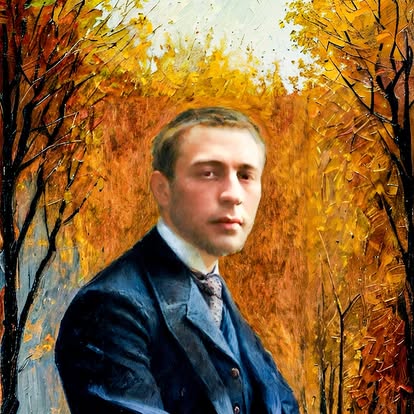
Sergei Rachmaninoff, born in Oneg, Russia on April 2, 1873, established himself as one of the most famous composers, conductors, and pianists of the late 19th and 20th centuries, in Russia, Europe and America. He often said, “I have chased three hares, composing, conducting and playing the piano. Can I be certain that I have captured even one?”
Despite the enormous popularity of his music and remarkable accomplishments as conductor and pianist, Rachmaninoff has had many detractors, both during his lifetime and later, who dismissed his music as being too conservative and out of step with modernism. A 1954 article in the Grove’s Dictionary of Music stated: “As a pianist, Rachmaninoff was one of the finest artists of his time, as a composer, he can hardly be said to have belonged to his time at all …
The enormous popular success of some few of Rachmaninoff’s works had in his lifetime is not likely to last…” In reality, Rachmaninoff’s music and artistry continue to thrive in popularity and his solo piano pieces, concertos and symphonic works are central to the modern concert and recording repertory. Other compositions such as his three operas, many songs and transcriptions are less familiar but are being performed more often. As for criticism of his composing style, Rachmaninoff wrote: “I cannot cast out the old way of writing, and I cannot acquire the new. I have made intense effort to feel the musical mood of today, but it will not come to me.” In another interview, he said: “In my own compositions, no conscious effort has been made to be original, or romantic, or nationalistic, or anything else. I write down on paper the music I hear within me, as naturally as possible. I am a Russian composer, and the land of my birth has influenced my temperament, and so it is Russian music. My music is the product of my temperament, and so it is Russian music…. What I try to do when writing down my music is to make it say simply and directly that which is in my heart when I am composing.”
An example of one of his first compositions while still a student from 1892 is his Trio élégiaque No. 1 in G Minor.
In this 3-part presentation, both well-known and less familiar music composed by Rachmaninoff will be highlighted. This includes music from his time in Russia up through 1917, and his accomplishments as a great pianist & conductor along with his last compositions during his exile period in America from 1918 until his death in 1943.
Rachmaninoff’s first musical training came from his family, who frequently brought him to Russian Orthodox Services, where he heard liturgical chants and church bells. In 1883, recognizing the boy’s unusual talent, a live-in piano teacher was hired who prepared Sergei for entrance to the St. Petersburg Conservatory. He was admitted based on his absolute pitch. However, due to misjudgments in placements in music theory classes, plus the tragedy of a broken home and the death of a sister, Rachmaninoff grew lazy and disinterested in school.
Pianist Alexander Siloti, a cousin of Rachmaninoff and later teacher, told Sergei’s mother: “I know only one man who can help him – my former teacher, Nikolai Zverev. The boy must go to Moscow and submit completely to his discipline.” His mother agreed, and in 1885 Rachmaninoff moved to Moscow, where he and two other students lived and studied with Zverev. They were strictly taught and supervised by Zverev and his sister, and took classes at the Moscow Conservatory taught by some of Russia’s greatest composers. It is here where he met and was admired and encouraged by Pyotr Tchaikovsky, the most famous Russian composer of the time. Upon graduation in 1891 at the age of 18, one year earlier than was usual, he received rare Gold Medals in both piano and composition. Later that year, Rachmaninoff composed his First Piano Concerto.
After his graduation with the title of “Free Artist”, at age 19 Rachmaninoff composed one of his most popular piano solos: The Prelude in C# Minor, a work that brought him fame and contempt, ease and annoyance. He first performed it at his professional piano debut in 1892, and Alexander Siloti played it in the USA and England. Rachmaninoff often lamented that he was repeatedly asked to play it as an encore at every concert. When asked about the meaning of the piece, Rachmaninoff told an interviewer: “Shortly after my graduation, I found myself out of pocket. I needed money, and I wrote this Prelude and sold it to a publisher for what he would give — I realized forty rubles, about twenty dollars in your money. It had no particular meaning. One day the Prelude simply came and I put it down.” Rachmaninoff recorded it on a piano roll in 1919.
As part of the requirements for his degree in composing, Rachmaninoff wrote his first opera in 17 days, Aleko, based on Pushkin’s Poem, The Gypsies. Its world premiere was at the Bolshoi Theater and was praised by Tchaikovsky.
In 1893, Tchaikovsky was so impressed by Rachmaninoff’s compositions that he planned to conduct The Rock, a tone poem written by Rachmaninoff, on an upcoming European tour. Unfortunately, Tchaikovsky suddenly died. When Rachmaninoff learned of this tragedy he expressed his grief by beginning to compose the Trio élégiaqueNo. 2 for piano, violin and cello as a tribute to Tchaikovsky.
Rachmaninoff became very depressed after the deaths of his grandmother and Tchaikovsky. During this period he did some composing and gave piano lessons. In 1895, he composed his First Symphony, which was given its world premiere 2 years later. He expressed excitement and strong personal feelings about this symphony, and held it close to his heart as a groundbreaking work. He said: “I believed I had opened up an entirely new path.” However, Alexander Glazunov, the conductor, had poorly prepared the orchestra. Several accounts claimed that at the world premiere, Glazunov was drunk. It was so painful for Rachmaninoff that he left the hall while the music was still playing, returning to face the audience and his peers once the performance was over. The experience was so painful that Rachmaninoff later remarked that he felt like a man who had a “stroke” or was ”paralyzed” by the sheer failure of the event. The composer César Cui compared it to a depiction of the 10 plagues of Egypt, and wrote that it would be admired by inmates in a conservatory in hell. It was not performed again in Rachmaninoff’s lifetime. However, it is now recognized as a great symphony and is performed worldwide.
As a result of the critical failure of his First Symphony, Rachmaninoff did very little composing over the next three years. He was engaged as a conductor at the Private Russian Opera Co. where he cemented his lifelong relationship with bass Feodor Chaliapin, but he remained very sensitive and moody. In an attempt to alleviate his depression, his aunt arranged for Rachmaninoff to visit the writer, Leo Tolstoy, who was a living legend and greatly admired by the composer. However, the visit did nothing to encourage the young Rachmaninoff. He became very self-critical and was suffering from writer’s block. His aunt then suggested he receive treatment from psychiatrist Dr. Nikolai Dahl, who administered daily hypnosis and psychotherapy sessions for several months. It worked!
In June and July of 1900 Chaliapin traveled to Italy with Rachmaninoff, who coached him on an upcoming opera production with Toscanini. During this visit, Rachmaninoff’s first to Italy, the Love Duet from his opera Francesca da Rimini was the first music he composed coming out of a three-year-long period of depression and writer’s block.
Francesca da Rimini was composed between 1900 and 1905. Based on Canto V of Dante’s Inferno, from his epic poem, The Divine Comedy, it is a tale of lust, unfaithfulness and murder. Historically, Francesca married her deformed husband, but is attracted to his handsome brother. They became lovers and were murdered by the jealous husband. The opera takes place in the 2nd circle of hell, the realm of those who are controlled by their lust, and where the murdered lovers now find themselves.
The Love Duet is one of Rachmaninoff’s finest dramatic achievements.
Rachmaninoff admitted that “The cure really helped me, and by the beginning of the summer I again began to compose. The material grew in bulk, and new musical ideas began to stir within me- more than enough for my concerto.” Ideas for the Second Concerto were put in order as were sketches for his second suite for two pianos. By the end of the summer, back in Russia, Rachmaninoff composed the 2nd and 3rd movements of his Second Concerto. It was completed in 1901 and dedicated to Dr. Dahl.
The first movement consists of ten dark, tolling chords reminiscent of the sounds of Russian Orthodox Church bells. The chords begin very softly and grow to a thunderous climax, leading to the orchestra’s entrance with one of the concerto’s main themes. Movement Two contains much poetry, beauty, warmth and rich orchestration.
In 1902, Rachmaninoff married one of his first cousins, Natalia Satina. They had two daughters, Irina and Tatiana. During those years, Rachmaninoff taught music at St. Catherine’s Women’s College.
He became conductor of the Bolshoi Theater in 1904 and instituted many significant changes in conducting techniques and insisted on high artistic standards. Up until the end of the 19th century there were no orchestra pits. Rachmaninoff implemented the design and construction of the orchestra pit thus ensuring that the orchestra would not be visible and therefore not be distracting to the audience.
Rachmaninoff’s 2nd and 3rd operas, The Miserly Knight and Francesca da Rimini, had their world premieres at the Bolshoi with Rachmaninoff conducting. In his memoirs, the composer Rimsky-Korsakov wrote: “In the early days of autumn I attended the premiere of my opera Pan Voyevoda, at the Bolshoi Theater in Moscow. The conductor was Sergei Rachmaninoff, a musician of rare talent.” He was indeed an excellent conductor.
After conducting 89 performances at the Bolshoi, Rachmaninoff quit his position due to the social and political tensions of the 1905 Revolution. He and his family moved to Dresden, Germany for a few years where his freer schedule allowed him more time to compose.
He was inspired by a black and white photograph of Arnold Böcklin’s painting The Isle of the Dead, which he viewed at an art gallery in Leipzig and composed his tone poem of the same name. Years later when he saw one of Böcklin’s 5 color versions of the painting, he stated that had he seen the color version first, he would not have composed this music. The dramatic painting depicts a small rowboat approaching a desolate rocky island cemetery. As usual, Rachmaninoff was very secretive about what he was trying to convey.
Although he still experienced periods of depression, apathy, and a lack of confidence in his compositions, Rachmaninoff began composing his 2nd Symphony while in Dresden. His work on the symphony went slowly, and was completed when he returned to Russia. Rachmaninoff conducted its world premiere on January 26, 1908. Critic, Yuri Engel, commented: “Despite his thirty-four years he is one of the most significant figures in the contemporary music world, a worthy successor to Tchaikovsky.”
This symphony contains some of the most beautiful and captivating melodies written by Rachmaninoff and has been used in many arrangements by pop singers.
During the period from 1892-1910, Rachmaninoff composed 24 Preludes for piano. The significance of the Preludes is twofold: 1) historically, they add to the contributions of Bach and Chopin of sets of preludes written in each of the major and minor keys, and 2) as idiomatic music, they define the technical, tonal, harmonic, rhythmic, lyrical and percussive qualities of the piano.
Among them is the C# Minor Prelude previously discussed, and possibly Rachmaninoff’s most famous & popular piece. Other of his Preludes will become better known as pianists perform them more often. The E-flat Major Prelude, reminiscent of passages from the Second Concerto, has great melodic charm and demonstrates Rachmaninoff’s ability to turn an accompaniment into a melody itself. The use of complex chords and rich chromatic devices produces sounds which are closely associated with the composer. In 1903, Rachmaninoff devoted himself to working on his ten Op. 23 Preludes, while awaiting the birth of his first child, Irina. On the day she was born, June 9, 1903, he sat down at the piano and composed this Prelude.
The 1887 painting “Die Heimkehr (The Homecoming) or (Return)” by the Swiss Symbolist Arnold Böcklin (1827-1901) shows a solitary figure seated with his back to a square reflecting pool.
His attention is focused on a shadowy house with a single lit window. The late autumn landscape suggests the falling veil of mortality, detachment and inevitability. This painting inspired Rachmaninoff to write the haunting Prelude in B Minor. According to his close friend, pianist Benno Moiseiwitsch, this Prelude held special significance for the composer, and remained a personal favorite. The composition clearly reflects the influence of its source by being more of a tone picture than a mere abstract piano piece.
Rachmaninoff and his family left Dresden for Moscow in early 1901 when he was asked to replace the famous conductor Arthur Nikisch in a series of orchestral concerts. In addition, the President of the Imperial Russian Musical Society appointed Rachmaninoff as Vice President to examine, correct, and improve the music conservatories and music training in general throughout Russia.
Back in his home in Ivanovka, Rachmaninoff began work on his Third Concerto to be introduced at his upcoming American Tour in 1909. He practiced the piano part on the way, using for the first time a silent piano on board the ship. The concerto was dedicated to pianist Josef Hofmann.
Rachmaninoff’s 1st recital in the United States was on November 4th, in Northampton, and on November 8th, his first American performance with orchestra was playing his Second Concerto with Max Fiedler and the Boston Symphony in Philadelphia. The world premiere of the Third Concerto took place on November 28, 1909 with Walter Damrosch and the New York Symphony Society. January 16, 1910, was the performance that Rachmaninoff most anticipated: the 3rd Piano Concerto with the NY Philharmonic under Gustav Mahler. Rachmaninoff praised Mahler’s conducting and his meticulous rehearsal techniques.
When asked about the origin of the opening theme of the Third Concerto, Rachmaninoff said: “It is borrowed neither from folk song forms nor from church sources. It simply wrote itself. If I had any plan in composing this theme, I was thinking only of sound. I want to “sing” the melody on the piano as a singer would sing it.” This theme exemplifies how Rachmaninoff can expand a simple motif into a totally engulfing melody.
In general, the American Tour was quite stressful for Rachmaninoff. He wrote: “America was a strain. Imagine giving an almost daily concert for nearly three months. I played only my own works. The success was great. They forced me to play as many as seven encores.” Music critics and audiences generally praised Rachmaninoff’s skills as a pianist but were far more reserved in the acceptance of his style of composing.
Rachmaninoff made his American conducting debut with the Philadelphia Orchestra with his own Second Symphony. He was highly praised as a conductor.
Before his departure, the Boston Symphony offered Rachmaninoff the post as permanent conductor, but the prospect of such a long absence from home and family struck him as absurd. He even refused contracts to return the following season.
Sergei Rachmaninoff’s music is saturated with the sound and symbolism of bells, to such an extent that they form one of the most distinctive signatures of his style. The tolling of Russian church bells that he heard as a child stayed with him all his life, shaping not only his ear for sonority, but also his sense of musical drama and spiritual meaning. Rachmaninoff once remarked: “The sound of church bells dominated all the cities of Russia I used to know … It is the most expressive sound that I know.” For him, bells were not just an ornament of Russian life, but an emotional experience. From his piano works to his orchestral and choral pieces, bells appear both literally and symbolically.
The most explicit example of his bell obsession is the Choral Symphony, The Bells, completed in 1913 and based on a Russian translation of Edgar Allen Poe’s poem by the same name. Rachmaninoff said that he considered it one of his favorite works, and it stands as a summation of his bell imagery on several levels: coloristic, structural, and philosophical.
Musically, The Bells is an encyclopedia of bell techniques. In the opening movement, the orchestra sparkles with high woodwinds, glockenspiel, triangle, and light strings that evoke the tingling of sleigh bells, while the chorus sings lines whose repeated notes and oscillating patterns suggest chiming metal. This symbolizes new beginnings, the vitality of youth, children’s laughter and happiness.
The Prelude in G# Minor, composed in 1910, is a well-known solo work whose ingratiating qualities and ingenious craftsmanship make it a most attractive work. As in so many of his compositions, Rachmaninoff presents a great variety of moods, ideas and pianistic color. After beginning with a shimmering accompaniment over a long, soulful melody, the composer creates numerous bell sounds and colors throughout the piece.
Rachmaninoff’s Fantasy, his First Piano Suite for Two Pianos, composed in 1893, is dedicated to Tchaikovsky. In its Fourth movement, entitled Russian Easter, a Carillon effect is created using thick chords and repeated octave figures which simulate the pealing of huge bells and evoke the joyous ringing of Moscow’s Kremlin bells and the grandeur of the Easter celebration.
Throughout World War I, Rachmaninoff, with the help of conductor Serge Koussevitzky, presented a number of benefit concerts for wounded soldiers and for the relief of the hungry. In that frame of mind, in less than two weeks during January and February in 1915, he composed his most important and most beloved liturgical work usually referred to as “Vespers” or “The All-Night Vigil. Rachmaninoff composed it for a chorus of boys and men. Performances of it to aid victims of W.W. I were very enthusiastically received. Rachmaninoff stated that he wanted the section (Now Let Thy Servant Depart) to be heard at his funeral.
In 1911, Rachmaninoff’s Moscow Conservatory composition teacher, Sergei Taneyev died, and even more impactful to him was the death of his friend, the composer Alexander Scriabin, at age 43 from blood poisoning. Rachmaninoff immediately began a concert tour playing Scriabin’s music to raise money for the composer’s widow. It was after those two deaths that Rachmaninoff composed Vocalise for soprano and orchestra. He also created a version for orchestra alone. Like the slow movement of the Second Symphony or the opening movement of the Third Concerto, the Vocalise stands as one of the most well known instances of Rachmaninoff’s distinctive lyricism. Developing from almost nothing, it creates a haunting sense of suspended time, melancholy and nostalgia.
By 1916, Russia was in the throes of World War I and teetering on the brink of Revolution. The world Rachmaninoff knew was beginning to collapse. Having retreated to his country estate in Ivanovka for some peace and quiet, he composed a number of songs, and what became his final work for solo piano before he left Russia. Completed in 1917, the Nine Etudes Tableau Op.39 (Study Pictures), are infused with a density of emotion and complexity that go far beyond mere technical study. Rachmaninoff was purposely vague about the programmatic content of these nine “tone pictures,” although he occasionally hinted at the imagery behind individual works.
The Etude Tableau OP. 39 #5 in E-flat minor clearly reflects the turmoil and anxiety Rachmaninoff must have been experiencing at this time.
As the Revolution of 1917 raged on, Rachmaninoff became increasingly concerned as his country home in Ivanovka was confiscated by communist authorities. The old order based on the absolute rule of the Czar broke down along with that of the Russian aristocracy. Rachmaninoff was desperate to find a way to leave the country. In what he attributed to “an act of God”, three weeks after the Revolution began, Rachmaninoff received a telegram from a Swedish concert manager offering a concert series in Stockholm. He accepted, and after borrowing money from friends and securing proper visas for his family, Rachmaninoff, his wife and children left Russia on December 23, 1917 with very little packed into their small suitcase. The trip was by train to the Finnish border, by open sled to the Swedish border, and finally by train to Stockholm, arriving after midnight.
Rachmaninoff departed Russia forever, but he left behind a gift benefiting generations of future Russian pianists and musicians: The Music Conservatory System he developed as Vice President of the Imperial Music Society.
Pianist Alexi Sultanov, born in Uzbekistan, was a product of that system. When he performed Rachmaninoff’s Piano Concerto #2 at the Van Cliburn International Piano Competition at age 18, he won the gold medal. This was the last composition Rachmaninoff played in Russia.